


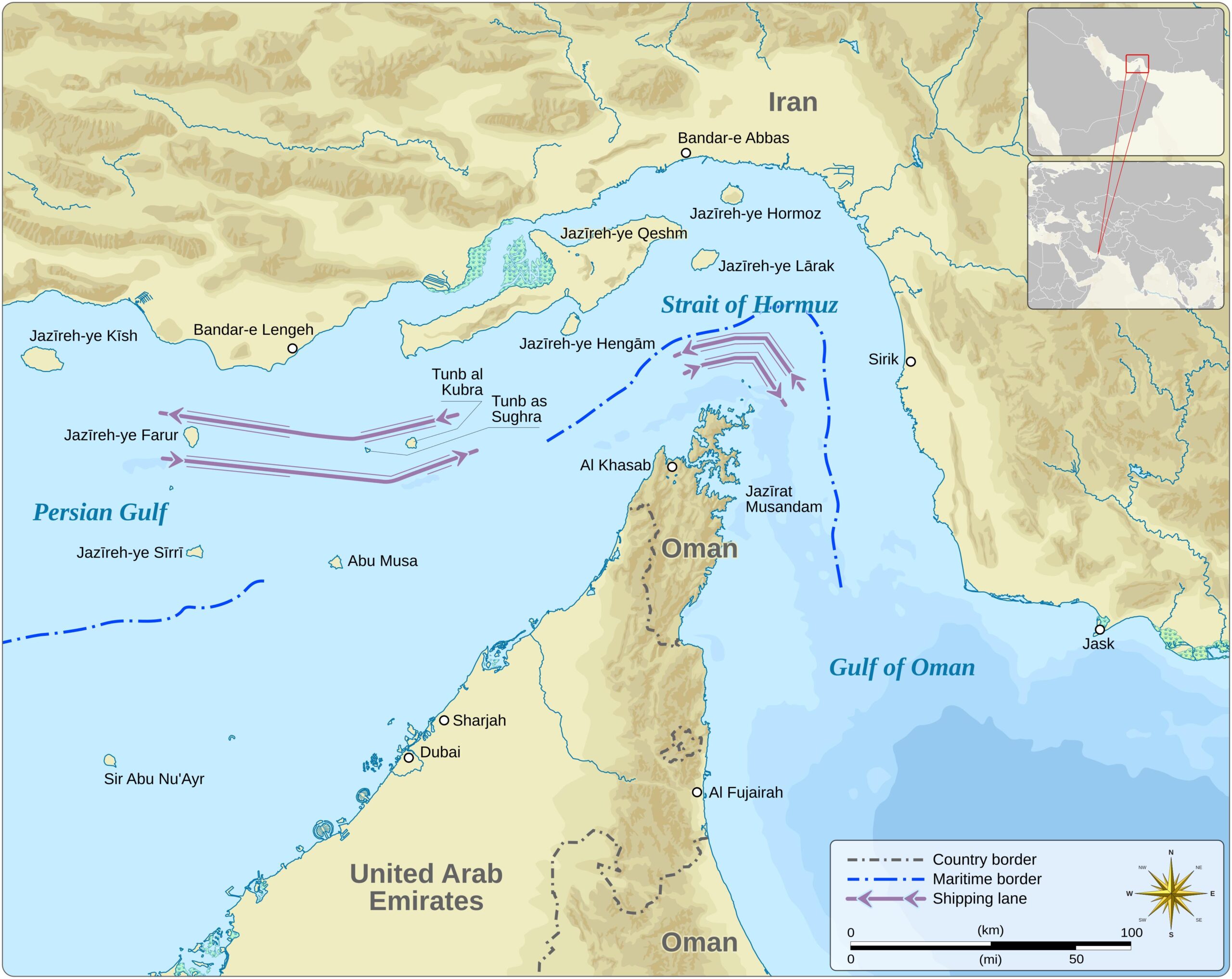
The Strait of Hormuz Is Not the Problem
For half a century, Western strategists have treated an assumption as gospel: that free passage through the Strait of Hormuz is worth going to war over.
Roughly one-fifth of the world’s seaborne oil passes through this 21-mile-wide channel between Iran and Oman,[1] and every major power has organized part of its defense posture around keeping it open.[6]
The pattern is by now a ritual. Tehran rattles a saber. Tanker insurance premiums jump. Crude spikes. Carrier groups reposition. Officials speak solemnly of “freedom of navigation,” as if the phrase itself were a deterrent.
The trouble is not Iran. It is the world’s insistence on running a fifth of its oil trade through a bottleneck that one regional power can threaten to close at will.
Diversify the supply, not just the fleet
The durable fix is not another squadron on station in the Gulf. It is making Hormuz strategically boring — a chokepoint that matters less each year because the world no longer needs it as much.
That means faster diversification of energy sources: more domestic production where it makes sense, modernized grids, expanded nuclear capacity, better batteries, and continued investment in alternative fuels.[2] The ideological argument over which of these should dominate is largely beside the point. Whether the preference runs toward hydrocarbons, atoms, or renewables, each new source chips away at the leverage any single chokepoint can exert. Energy security, in this sense, has simply become a subset of national security.[3]
The politics make this harder than the engineering. In Washington, energy policy has fused with tribal identity; a pipeline or a wind farm is read as a partisan signal before it is judged as infrastructure. The predictable result is a policy process that reacts to each Gulf crisis in turn rather than shrinking the vulnerability that produces them.[5]
Reasonable people disagree about how the current administration has handled the wider Middle East file. Critics say its choices have raised the temperature in the Gulf without addressing the structural dependence that makes Hormuz a lever in the first place. Its defenders counter that deterrence still has to hold the line while the slower work of diversification plays out.[13] Both sides can be right about their piece of the argument, and the larger question survives the debate intact: how does the world stop needing this one stretch of water so badly?[4]
Cheap weapons, expensive ships
A second lesson is emerging from recent wars, and it cuts against a century of naval doctrine.
Since the age of dreadnoughts, great powers have projected power through big, expensive platforms — carriers, cruisers, destroyers, amphibious ships.[15] These vessels remain formidable. But Ukraine’s war against Russia has shown how exposed they can be to weapons a fraction of their cost.
Ukraine has no blue-water navy to speak of. It nonetheless pushed a large share of Russia’s Black Sea Fleet out of its home waters near Crimea, using long-range missiles, maritime drones, and targeting intelligence rather than ships.[9] Vessels worth hundreds of millions of dollars found they could not safely operate within range of weapons costing a rounding error of that sum.[8]
This is not a footnote. Military history turns on exactly this kind of arithmetic: gunpowder made castles pointless, aircraft ended the battleship’s reign, precision munitions gutted massed armor.[11][12] Drones, cruise missiles, anti-ship ballistic missiles, and unmanned surface craft look like the next entry on that list.[14]
None of this retires the aircraft carrier. Power projection, disaster response, deterrence-by-presence — surface fleets still do things nothing else can.[7][10] But the old assumption that a navy can simply guarantee open sea lanes anywhere on the map deserves a harder look, now that adversaries can hold billion-dollar platforms at risk with weapons costing thousands of dollars, sometimes less.[14]
The real fix is boring
Put the two arguments together and a single strategic conclusion follows: the world’s answer to Hormuz will not come from another deployment. It will come from engineering, economics, and energy policy — the unglamorous work of making a chokepoint irrelevant rather than defending it indefinitely.
Great powers that endure tend to be the ones that eliminate their vulnerabilities rather than garrison them forever.
Endnotes
- U.S. Energy Information Administration, World Oil Transit Chokepoints (Washington, DC: EIA, June 25, 2024), pp. 2–6, eia.gov.
- International Energy Agency, Oil 2025: Analysis and Forecast to 2030 (Paris: IEA, 2025), pp. 45–52, iea.org.
- U.S. Department of Energy, National Energy Security Framework (Washington, DC, 2024), pp. 7–15, energy.gov.
- Hal Brands, The Eurasian Century: Hot Wars, Cold Wars, and the Making of the Modern World (New York: W. W. Norton, 2025), pp. 184–195.
- Eliot A. Cohen, Supreme Command (New York: Free Press, 2002), pp. 167–175.
- Milan Vego, Naval Strategy and Operations in Narrow Seas (London: Routledge, 2013), pp. 93–111.
- Phillips Payson O’Brien, The Second Most Powerful Man in the World: The Life of Admiral William D. Leahy (New York: Dutton, 2019), pp. 281–290.
- Stephen Biddle, “Back in the Trenches,” Foreign Affairs 103, no. 1 (2024): 16–30, foreignaffairs.com.
- Michael Kofman and Rob Lee, “Lessons from Ukraine’s Maritime Campaign,” War on the Rocks, 2024, warontherocks.com.
- International Institute for Strategic Studies, The Military Balance 2025 (London: Routledge for IISS, 2025), pp. 186–193, iiss.org.
- Norman Friedman, Network-Centric Warfare: How Navies Learned to Fight Smarter Through Three World Wars (Annapolis, MD: Naval Institute Press, 2009), pp. 298–305.
- Wayne P. Hughes Jr. and Robert Girrier, Fleet Tactics and Naval Operations, 4th ed. (Annapolis, MD: Naval Institute Press, 2018), pp. 379–402.
- U.S. Department of Defense, 2022 National Defense Strategy of the United States (Washington, DC, 2022), pp. 4–18, media.defense.gov.
- Naval War College Review, various articles on anti-access/area-denial (A2/AD) strategy and naval vulnerability, Vol. 77 (2024), digital-commons.usnwc.edu.
- Alfred Thayer Mahan, The Influence of Sea Power Upon History, 1660–1783 (Boston: Little, Brown, 1890), pp. 25–48, archive.org.

Be the first to comment